Understanding PFAS movement in unsaturated soil: The impact of plant water uptake and soil organic carbon
A recent study by Biesek et al. provides new insights via numerical simulations into how the root zone of plants and the distribution of organic carbon in the soil affect PFAS movement. The study investigated the effects of soil organic carbon (SOC) distribution and water uptake by plant roots on PFAS movement in the vadose zone under temperate, humid climate conditions.
May 6, 2025
By applying the HYDRUS computer code to model the leaching of historical PFOS contamination and the infiltration of water contaminated with PFOA. The study considered various soil profiles with different SOC distributions, including no SOC, a realistic SOC distribution decreasing with depth, and a uniform SOC equal to the content measured in topsoil. Additionally, three root distributions (bare soil, grassland, and forest) and three soil textures (sand, sandy loam, and loam) were examined.
The study found that the way organic carbon is distributed in the soil affects how fast PFOS moves. When organic carbon is distributed realistically PFOS moves twice as slow compared to when there is no SOC and even three times as slow compared to uniformly high SOC content in. Furthermore, the root distribution in soil plays a significant role in PFAS migration. Including the root zone in the simulations showed that it slows down the movement of PFAS primarily due to increased evapotranspiration and reduced downward water flux. Another effect of water uptake by plant roots is an increase in PFAS concentrations in soil water, known as evapoconcentration. This evapoconcentration and the slowdown of PFAS movement due to root water uptake are more pronounced in fine-textured soils than in sand.
Want to learn more about how these findings can improve our understanding of PFAS movement through soil? Read the full article “Numerical modelling of PFAS movement through the vadose zone: Influence of plant water uptake and soil organic carbon distribution” by Biesek et al. for an in-depth analysis.
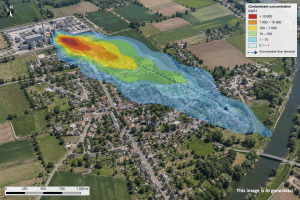
Dynamics of PFAS transport in the unsaturated zone: Insight from long-term monitoring of an AFFF-contaminated site
PFAS in the unsaturated zone can remain a long-term source of groundwater contamination. A two-year Danish field study shows that precipitation and infiltration, soil composition and secondary PFAS reservoirs control mobilisation and vertical transport, with distinct behaviour for short- and long-chain PFAS.
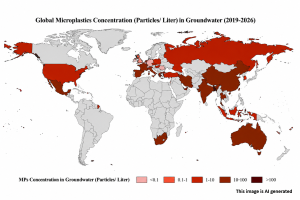
Microplastics in groundwater: An updated systematic review of occurrence, hydrogeological controls, methodological challenges, and regulatory gaps
Microplastics are increasingly detected in groundwater, yet their occurrence, transport and environmental relevance remain difficult to assess. A systematic review of 82 field studies from 28 countries demonstrates their presence across a wide range of hydrogeological settings. Large differences in reported concentrations are strongly influenced by inconsistent sampling and analytical methods. Standardised monitoring is therefore essential for developing reliable groundwater quality criteria and future regulatory frameworks.
PFAS and the pollution trap: contested knowledge in environmental justice struggles
PFAS contamination is not only an environmental and health issue, but also a challenge of environmental justice and access to reliable knowledge. Based on 25 documented PFAS conflicts worldwide, this study examines how scientific uncertainty, chemical persistence and information asymmetries shape affected communities. The authors describe how the largely invisible nature of PFAS contamination can delay recognition and regulatory action. The study highlights the importance of combining scientific evidence with the experiences and knowledge of exposed communities.
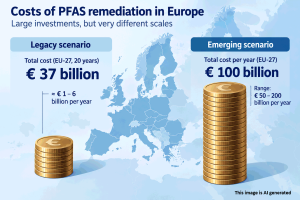
PFAS remediation across Europe: costs and limited impacts
PFAS contamination is widespread across Europe, but removing these persistent chemicals from the environment is technically difficult and extremely costly. This study estimates the costs and potential impact of large-scale PFAS remediation across the EU. Even extensive treatment of contaminated soil, drinking water, wastewater, sludge and landfill leachate would remove only a small fraction of ongoing emissions. The results demonstrate that remediation must be combined with strong control of PFAS emissions at their source.
Accumulation of PFAS in wine from a contaminated area: perfluorobutanoic acid (PFBA) as a molecular marker of PFAS groundwater contamination and implications of wine ingestion for human health
PFAS contamination of groundwater can also affect agricultural products and contribute to human exposure through food and beverages. This study investigated PFAS in wines produced within and around a major contaminated area in Northern Italy. Short-chain PFAS, particularly perfluorobutanoic acid (PFBA), were frequently detected and linked to local groundwater contamination. The results suggest that wine may serve both as a bioindicator of groundwater contamination and as a potential dietary exposure pathway.
This website makes use of cookies to function properly. If you would like to change which cookies we can use, change the cookie settings. Read more about our use of cookies in our privacy policy.