Understanding PFAS movement in unsaturated soil: The impact of plant water uptake and soil organic carbon
A recent study by Biesek et al. provides new insights via numerical simulations into how the root zone of plants and the distribution of organic carbon in the soil affect PFAS movement. The study investigated the effects of soil organic carbon (SOC) distribution and water uptake by plant roots on PFAS movement in the vadose zone under temperate, humid climate conditions.
May 6, 2025
By applying the HYDRUS computer code to model the leaching of historical PFOS contamination and the infiltration of water contaminated with PFOA. The study considered various soil profiles with different SOC distributions, including no SOC, a realistic SOC distribution decreasing with depth, and a uniform SOC equal to the content measured in topsoil. Additionally, three root distributions (bare soil, grassland, and forest) and three soil textures (sand, sandy loam, and loam) were examined.
The study found that the way organic carbon is distributed in the soil affects how fast PFOS moves. When organic carbon is distributed realistically PFOS moves twice as slow compared to when there is no SOC and even three times as slow compared to uniformly high SOC content in. Furthermore, the root distribution in soil plays a significant role in PFAS migration. Including the root zone in the simulations showed that it slows down the movement of PFAS primarily due to increased evapotranspiration and reduced downward water flux. Another effect of water uptake by plant roots is an increase in PFAS concentrations in soil water, known as evapoconcentration. This evapoconcentration and the slowdown of PFAS movement due to root water uptake are more pronounced in fine-textured soils than in sand.
Want to learn more about how these findings can improve our understanding of PFAS movement through soil? Read the full article “Numerical modelling of PFAS movement through the vadose zone: Influence of plant water uptake and soil organic carbon distribution” by Biesek et al. for an in-depth analysis.
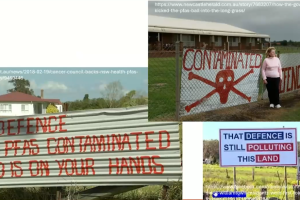
Webinar 1 – 2026 The Australian PFAS Cauldron – Same Contaminants, Different Journey
Australia offers a highly relevant case study of how PFAS contamination challenges conventional approaches to environmental governance and risk assessment. This perspective was presented by Matthew Askeland, Principal Environmental Scientist at ADE Consulting Group, and Karl Bowles, Senior Principal Environmental Scientist at Jacobs and Adjunct Associate Professor at the University of Queensland (QAEHS), both representing ALGA’s Emerging Contaminants of Concern Special Interest Group.
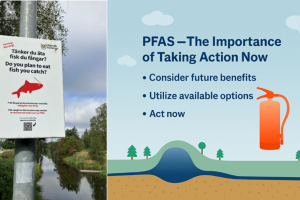
Webinar 2 – 2026 Drivers in the management of PFAS contaminated sites
Sweden has taken a proactive, science-based approach to managing PFAS-contaminated sites, particularly those originating from historical use of aqueous film-forming foams (AFFF) at firefighting training areas. Since 2022, the Swedish Environmental Protection Agency (EPA) has coordinated a governmental assignment, in collaboration with other authorities, to enhance understanding of PFAS pollution and develop effective remediation strategies. This work remains ongoing with several years of funding secured. Niclas Johansson, project manager for the Swedish government’s national initiative on PFAScontaminated sites (RUPFO), shared the project findings during the webinar.
Webinar 3 – 2026 PFAS Risk Evaluation in Soils and Excavated Materials in Flanders
Flanders has developed a practical, science-driven system for setting PFAS limits in soil and excavated materials. This approach carefully balances the protection of human health and the environment with the practical need for soil reuse. The framework was presented by Kaat Touchant and Ingeborg Joris from VITO the Flemish institute for technological research.
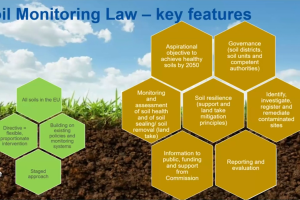
Webinar 4 – 2026 Emerging Contaminant Challenges in the New European Soil Monitoring Law
The European Soil Monitoring Law (Directive), published in the Official Journal on 26 November 2025 and entering into force on 16 December 2025 was presented by Esther Goidts, who is a soil scientist and seconded policy officer at the European Commission. Soils deliver critical ecosystem services—including food and biomass production, water purification, nutrient cycling, carbon sequestration, and biodiversity support—yet most European soils are degraded, with contamination contributing to annual economic costs exceeding €50 billion. The Directive represents a landmark step toward achieving healthy soils across the European Union by 2050. Developed to address widespread soil degradation, the Directive establishes a coherent, integrated framework for monitoring soil health, enhancing resilience, and managing contamination.
Save the date for the EmConSoil Webinar Series on the 21st and 28th of April and the 5th and 12th of May!
A new EmConSoil webinar series is coming! Get ready for inspiring talks, cutting-edge insights, and practical solutions from leading experts in emerging contaminants, contaminated soils and environmental sustainability. Four sessions are planned at the end of April (21st and 28th) and beginning of May (5th and 12th) 2026 each time from 9:00 till 10:00 CET.
This website makes use of cookies to function properly. If you would like to change which cookies we can use, change the cookie settings. Read more about our use of cookies in our privacy policy.