Webinar 4 – 2026 Emerging Contaminant Challenges in the New European Soil Monitoring Law
The European Soil Monitoring Law (Directive), published in the Official Journal on 26 November 2025 and entering into force on 16 December 2025 was presented by Esther Goidts, who is a soil scientist and seconded policy officer at the European Commission. Soils deliver critical ecosystem services—including food and biomass production, water purification, nutrient cycling, carbon sequestration, and biodiversity support—yet most European soils are degraded, with contamination contributing to annual economic costs exceeding €50 billion. The Directive represents a landmark step toward achieving healthy soils across the European Union by 2050. Developed to address widespread soil degradation, the Directive establishes a coherent, integrated framework for monitoring soil health, enhancing resilience, and managing contamination.
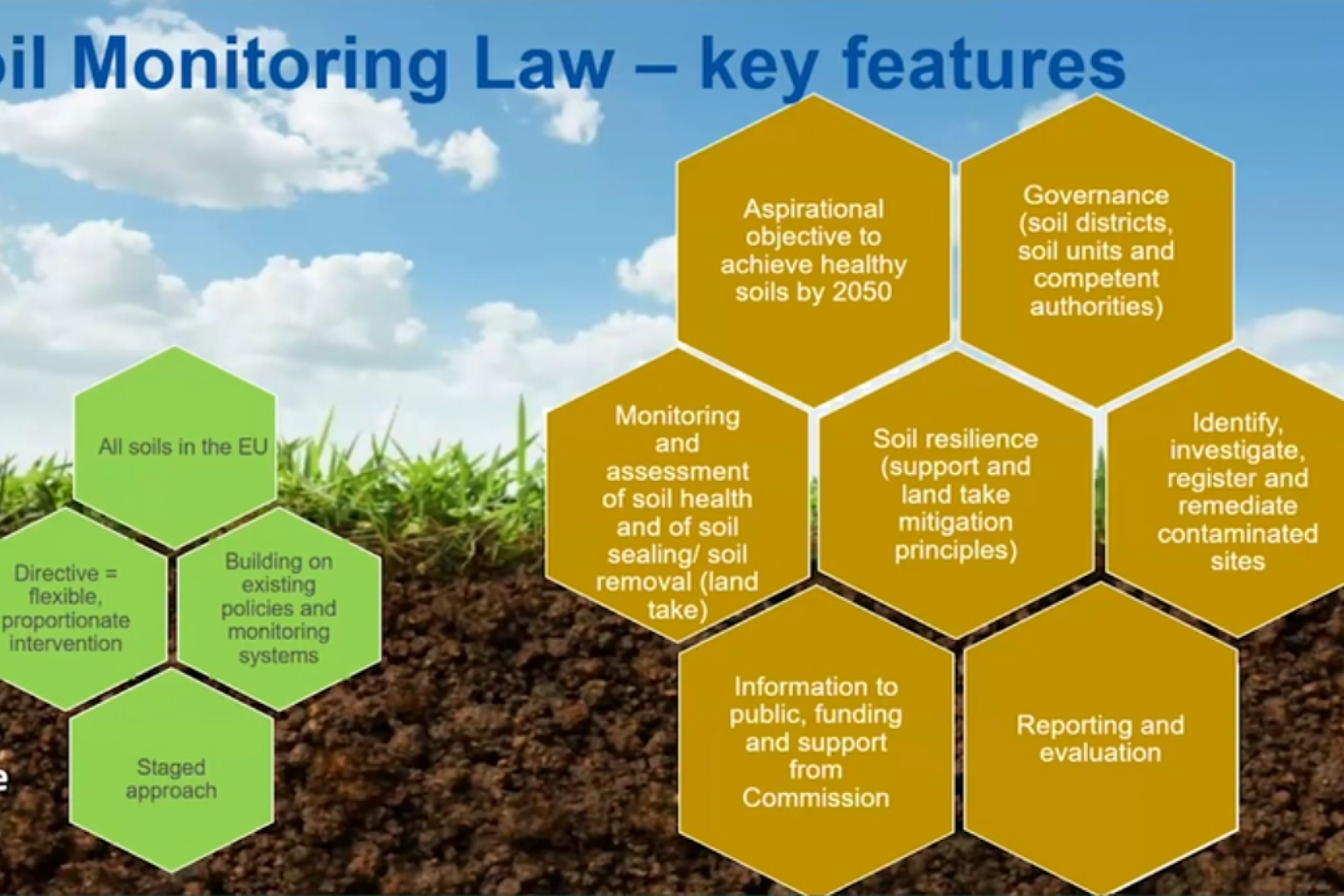
The Directive applies to all soils irrespective of land use and takes the form of a Directive, allowing Member States flexibility in national transposition by December 2028 while ensuring proportionate implementation. It adopts a staged approach: initial emphasis on comprehensive monitoring, followed by targeted support measures and remediation. Its structure rests on three main pillars: (1) monitoring and assessment of soil health, sealing, and removal; (2) support for soil resilience and land-take mitigation; and (3) systematic management of contaminated sites.
Soil health is defined as the capacity of soil to sustain its physical, chemical, and biological conditions while delivering ecosystem services, taking environmental, social, and economic factors into account. Monitoring operates on 6-year cycles (three years for sealing and removal indicators using Copernicus remote sensing data) and is organized through soil districts (administrative units) and soil units (homogeneous areas defined by soil type and land use). Descriptors are categorized in Annex I of the Directive, with associated criteria divided into sustainable target values (non-binding) and operational trigger values.
Chemical contamination monitoring receives particular attention in the webinar. Part B descriptors, monitored across the full network, include heavy metals (with an EU minimum list) and selected organic contaminants chosen by Member States, considering existing EU legislation such as the Persistent Organic Pollutants Regulation. Part C focuses on emerging contaminants monitored on representative subsets of sampling points: per- and polyfluoroalkyl substances (PFAS), pesticide active substances and metabolites, plus optional other emerging contaminants. Microplastics are explicitly highlighted in the recitals as a relevant candidate for future inclusion. Member States must develop a priority list of high-risk contaminants based on toxicity, persistence, mobility, sources, and data gaps. To support this process, the European Commission will publish an indicative list of soil contaminants by mid-2027 in cooperation with Member States.
For historically contaminated sites (point-source anthropogenic pollution), the Directive requires a risk-based, stepwise approach: identification of potentially contaminated sites, site investigation, conceptual site modelling, site-specific risk assessment, and remediation where unacceptable risks to human health or the environment are identified. A public register with overview of potentially contaminated sites and stakeholder participation are mandatory. Background levels (natural and anthropogenic) must be considered in risk evaluations.
Horizontal provisions emphasize transparency, public access to information, laboratory quality assurance, and integration of soil monitoring data into other EU policies, including the Common Agricultural Policy, Nature Restoration Regulation, Water Framework Directive, and climate and biodiversity strategies. The Commission will provide substantial support through the 2027 LUCAS soil campaign (topsoil sampling and monitoring initiative coordinated by the European Commission's Joint Research Centre (JRC) and Eurostat), guidance documents, and a dedicated Soil Monitoring Law Expert Group established in January 2026.
Key implementation challenges include harmonizing sampling and analytical methodologies, distinguishing diffuse versus point-source contamination, defining acceptable risk thresholds, managing costs, and effectively communicating with the public on contamination issues. Integrating the broader soil health concept into traditional contaminated site management also remains complex. Emerging contaminants pose particular difficulties due to limited occurrence data, evolving analytical methods, and the need for adaptive prioritization.
In the short term, non-binding guidance on monitoring network design, target and operational values, indicative list, risk assessment methodologies, and best practices will be developed. Over the longer term, the Directive promotes continuous knowledge exchange, cross-border cooperation, and research through European projects and living labs. By fostering a dynamic, evidence-based system, the legislation seeks to halt soil degradation, reduce contamination risks, and ensure soils can sustainably provide multiple ecosystem services for future generations.
This new framework offers a flexible yet ambitious structure that explicitly incorporates emerging contaminants, positioning the scientific and regulatory community—supported by networks such as EmConSoil—to play a vital role in its successful implementation.
Share this post!