PFAS remediation across Europe: costs and limited impacts
PFAS contamination is widespread across Europe, but removing these persistent chemicals from the environment is technically difficult and extremely costly. This study estimates the costs and potential impact of large-scale PFAS remediation across the EU. Even extensive treatment of contaminated soil, drinking water, wastewater, sludge and landfill leachate would remove only a small fraction of ongoing emissions. The results demonstrate that remediation must be combined with strong control of PFAS emissions at their source.
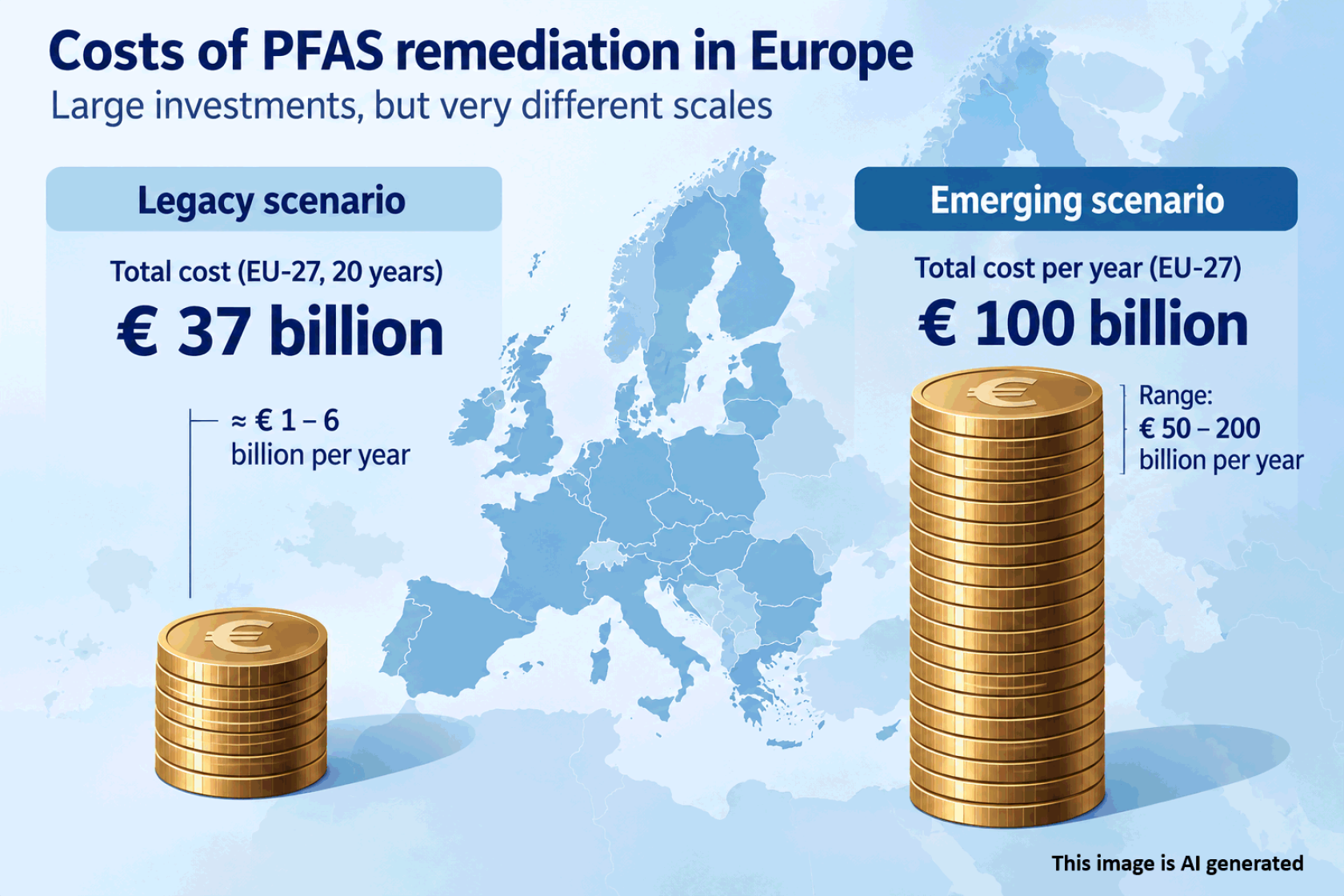
PFAS concentrations in the European environment continue to increase because of ongoing emissions. This study evaluates whether large-scale remediation could substantially reduce this contamination and estimates the associated costs across the EU-27. Two scenarios are considered: a legacy scenario, targeting previously emitted and widely regulated long-chain PFAS, and an emerging scenario, covering nearly all PFAS, including short- and ultra-short-chain compounds.
The legacy scenario focuses on selected highly contaminated soil sites, landfills and drinking water. The estimated central cost is approximately €37 billion over 20 years, equivalent to about €1.8 billion per year, with estimated annual costs in the order of €1–6 billion. Such remediation could substantially reduce exposure at contaminated hotspots and thereby reduce associated health impacts.
The much broader emerging scenario also addresses shorter-chain PFAS and includes large drinking-water zones, wastewater-treatment-plant effluents, agriculturally applied sewage sludge and collected landfill leachate. The estimated central cost is approximately €100 billion per year, with estimates ranging roughly from €50 to €200 billion annually. These much higher costs reflect both the larger number of environmental media requiring treatment and the greater technical difficulty of removing mobile short- and ultra-short-chain PFAS.
Despite this enormous investment, the environmental impact would remain limited. The emerging scenario includes treatment of 1,636 heavily contaminated European soil sites, together with major wastewater, drinking-water, sludge and landfill-leachate streams. Nevertheless, it would address only approximately 3–50 tonnes per year of PFAAs and their precursors, corresponding to less than 2% of estimated current EU PFAS emissions. Important emission pathways, including industrial wastewater and atmospheric emissions, are not fully addressed by the scenario.
The study therefore concludes that remediation is important for reducing exposure at contaminated hotspots and protecting drinking water but cannot compensate for continued large-scale PFAS emissions. Even very high expenditure on remediation would address only a small fraction of the continuing PFAS load. The authors therefore identify source control and restrictions on PFAS use as essential: preventing new PFAS emissions is expected to be considerably more effective and less costly than attempting to remove PFAS after they have become widely dispersed in the environment.
The full article is available here
Share this post!